
OEM Hydrogen Generator Integration Solutions for Equipment Manufacturers and System Integrators
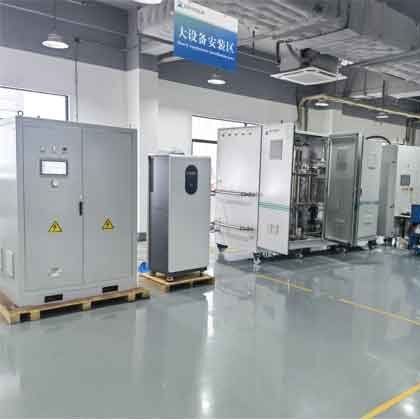
OEM hydrogen generator
OEM Hydrogen Integration Solution
OEM hydrogen generator solutions for equipment manufacturers and integrators. Modular PEM systems, engineering support, interface customization and prototype-to-batch workflow.
Why OEM Hydrogen Integration Requires More Than a Standard Product
Many customers do not need a standalone hydrogen generator sitting beside their equipment. They need hydrogen capability built into the equipment itself. That is where OEM hydrogen integration becomes essential.
A standard off-the-shelf unit may be useful for general deployment, but OEM customers often have very different requirements:
Space constraints
Interface requirements
Electrical integration logic
Control architecture
Enclosure limitations
Application-specific flow ranges
This is why an OEM hydrogen generator solution is not simply a smaller version of a standard product. It is a system integration task.
BYEAST supports OEM hydrogen integration for customers who need compact PEM hydrogen capability embedded into equipment, systems, platforms, or specialized applications.
The Problem with Using Standard Products for OEM Projects
A standard product is designed to work in a general environment. OEM projects are rarely general.
Typical limitations of standard units include:
1. Size mismatch
The system may be too large, poorly shaped, or difficult to fit into the target equipment.
2. Interface mismatch
Gas, electrical, mechanical, and control interfaces may not align with the host machine.
3. Control incompatibility
The target equipment may require specific signal behavior, alarms, interlocks, or control logic.
4. Non-optimized architecture
An OEM customer may not need a complete stand-alone system. They may only need the right hydrogen module, integrated in the right way.
5. Poor support for prototype-to-batch transition
A one-off custom adaptation is not enough. OEM projects need a workable development path.
This is why many OEM users need a partner who understands not only hydrogen generation, but integration logic.
Depending on the application, support may include:
This solution is designed for customers who do not want to begin with a blank sheet, but who also cannot use a fully standard system unchanged.
Solution Overview: OEM Hydrogen Integration with Modular PEM Systems
BYEAST offers OEM hydrogen integration solutions based on compact PEM hydrogen generation technology. The goal is to help equipment manufacturers and system integrators add hydrogen functionality in a practical, controllable, and scalable way.

Who This Solution Is For
OEM hydrogen integration is especially relevant to:
-★ laboratory equipment manufacturers
-★ semiconductor equipment makers
-★ compact industrial system builders
-★ research platform developers
-★ energy system integrators
-★ niche mobility or fueling concept developers
In these cases, the hydrogen function is part of the final machine or system, not an external utility product.
What an OEM Hydrogen Solution Must Solve
An effective OEM hydrogen generator solution must address several layers at once.
System fit
Can the hydrogen subsystem physically fit inside the host product?
Interface logic
Can gas, electrical, and control interfaces match the target machine?
Operating behavior
Can the hydrogen module support the expected flow, response, and reliability requirements?
Engineering feasibility
Can the integration be built, tested, and supported without excessive complexity?
Commercial continuity
Can the project move from prototype to repeatable supply?
These questions are what separate real OEM integration from simple product resale.
Typical Integration Models
Not all OEM hydrogen projects look the same. Common models include:
Embedded hydrogen module
The customer integrates a compact hydrogen generation module into their own equipment architecture.
Customized compact hydrogen unit
The customer uses a modified system adapted to fit their machine or platform.
Platform-level cooperation
The hydrogen subsystem is developed with a broader engineering relationship in mind, including validation and scaling.
Each model has different engineering and commercial implications, but all require clarity from the beginning.
Recommended Product Base
Discuss your OEM hydrogen integration project with our engineering team
Prototype to Batch Workflow
One of the biggest problems in OEM projects is the gap between a demo sample and a supply-ready product path. BYEAST supports a practical project flow that helps close this gap.
A typical OEM workflow may include:
1. Requirement discussion
Define the application, flow demand, integration logic, space constraints, and project goals.
2. Preliminary system direction
Identify whether a standard-adapted, modular, or more customized approach is appropriate.
3. Prototype planning
Establish the first-stage integration concept and validation path.
4. Testing and review
Evaluate fit, function, operating logic, and required changes.
5. Pilot or small-batch support
Move toward a more repeatable supply structure if the project is successful.
This workflow matters because OEM success depends on more than hardware. It depends on development discipline.
Integration & Engineering Considerations
OEM hydrogen integration is not just a matter of shipping a module. It requires alignment at multiple technical levels.
Key considerations include:
-★ gas connection and routing
-★ enclosure layout
-★ electrical input and wiring
-★ communication and control logic
-★ alarm and safety behavior
-★ maintainability and service access
-★ thermal and environmental conditions
BYEAST supports engineering-level communication for customers who need hydrogen capability to behave properly inside a wider machine or platform.
Our strengths include:
-★ modular PEM architecture
-★ engineering-oriented communication
-★ practical fit for compact systems
-★ OEM support mindset
-★ ability to support prototype-to-batch progression
We are not positioned as a mass-market standard equipment brand trying to force one catalog onto every customer. We work best where the application matters
Why BYEAST
BYEAST focuses on compact PEM hydrogen systems that fit real engineering use cases. We are especially relevant to customers who need hydrogen functionality in specialized, embedded, or integration-driven environments.
Frequently Asked Questions
Can you provide fully custom OEM hydrogen systems?
We support OEM-oriented solutions with varying degrees of adaptation depending on application needs and feasibility.
Do you only work with large-volume OEM projects?
No. Pilot, prototype, and smaller specialized OEM projects can also be relevant.
Can your systems be integrated into lab or semiconductor equipment?
Yes. These are among the types of use cases where compact hydrogen integration is especially relevant.
What is the first step in an OEM project?
The first step is usually application discussion: required flow, equipment type, interface expectations, and project stage.